
Dr. Esin Özlem Atmış
Facial Surgery
Facial plastic surgery in Istanbul, from the eyelids and brows to the deep plane facelift, planned by looking at the face as a whole.
Facial surgery · Overview
Start with the face as a whole.
This section explains the facial operations performed by Op. Dr. Esin Özlem Atmış: eyelid surgery, brow lift, almond eye surgery, endoscopic midface lift, deep plane facelift and neck lift, double chin surgery, lip lift, otoplasty and buccal fat removal.
Each page explains who the operation suits and who it does not, how to prepare (including blood thinners), recovery, risks and how to plan a stay in Istanbul. International patients usually start with an online consultation.
In short
- Nine facial operations, each with its own page, risks and recovery table.
- The deep plane technique is used for facelifts.1
- Blood thinners, supplements and smoking are reviewed weeks before any operation.2,3
- Arrive at least one day before surgery for the anaesthesia assessment.
- Follow-up at 1, 3, 6 and 12 months, online if you live abroad.
Which area is changing?
Choose the area that bothers you most. Each page explains what the operation can and cannot change, preparation, recovery and travel planning.
Eyes, brows and upper face
Eyelid surgery (blepharoplasty) ↗
Heavy upper eyelids and bags under the eyes.
Brow lift ↗
A low or heavy brow that makes the eyes look hooded or tired.
Almond eye surgery ↗
The angle and length of the outer corner of the eye.
Cheeks and lower face
Facelift and neck lift ↗
Deep plane lift for cheeks, jowls, jawline and neck.
Endoscopic midface lift ↗
Descended cheeks and the eyelid–cheek junction.
Buccal fat removal ↗
Fullness of the lower cheeks, planned conservatively.
Double chin surgery ↗
Fat under the chin, liposuction and laser lipolysis.
Lips and ears
Lip lift ↗
A long upper lip and little visible upper teeth.
Otoplasty ↗
Prominent ears in children and adults.
Nasal surgery is covered separately on the rhinoplasty page and in the ENT and nasal surgery section.
Surgery, a smaller step, or no surgery
Facial ageing is not one problem. Skin, fat, muscle, the deeper support layers and bone change at different speeds, and a request (“I want a facelift”, “I want almond eyes”) is not automatically the right treatment.
- Some concerns need surgery, because only surgery can reposition descended tissue; for example, non-surgical treatments cannot achieve the results of a neck lift.4
- Some are better treated with a smaller procedure, or by treating a neighbouring area: upper eyelid surgery cannot lift a low brow.5
- Some are better left alone for now, or not treated at all, for example removing cheek fat in a face that will lose fat with age.6
How a plan is made
01 · Understand
What bothers you, how it affects you and what you would not want to change.
02 · Examine
The whole face: skin, fat, muscle, bone support, eyelid function and symmetry.
03 · Check safety
Medicines, bleeding history, blood pressure, diabetes, smoking and anaesthesia risk.
04 · Plan and follow
The smallest effective plan, and follow-up at 1, 3, 6 and 12 months.
Safety before any facial surgery
Every facial operation starts with the same safety review, weeks before surgery:
- blood thinners such as warfarin, apixaban, rivaroxaban, clopidogrel or aspirin are reviewed with the doctor who prescribed them; they are never stopped on your own;2
- supplements that increase bleeding, such as vitamin E, ginkgo, garlic and ginseng, are usually stopped at least two weeks before;7
- all nicotine, including vapes, is stopped three to six weeks before and after surgery;3
- weight-loss injections (GLP-1 medicines) are discussed with the anaesthesia team;8
- a known bleeding disorder, or a history of unusual bleeding, is assessed with blood tests before any plan; people whose blood cannot clot normally are not candidates for a facelift.9
Each procedure page includes a detailed table of what usually happens with each medicine.
Travelling to Istanbul for facial surgery
Many patients travel from other cities or countries. A clear plan makes the trip calmer and safer:
- Online consultation first: most international patients start with an online consultation. Send your concern, your medical history, your medicines and a few clear photos through the channel the practice arranges, before you book flights.
- Arrive at least one day before surgery: the anaesthesia assessment and the final examination take place before the day of the operation.
- Hospital stay: usually one night after a facelift, neck lift, midface lift or brow lift; a second night is optional. Smaller procedures are often same-day.
- Time in Istanbul: this depends on the operation: about seven days after a facelift or neck lift, five to seven days after eyelid or almond eye surgery, and shorter for smaller procedures.
- Follow-up: reviews are planned at 1 month, 3 months, 6 months and 1 year. They can be done online if you live abroad; you will know whom to contact for urgent questions after you return home.
Dr. Atmış and facial surgery
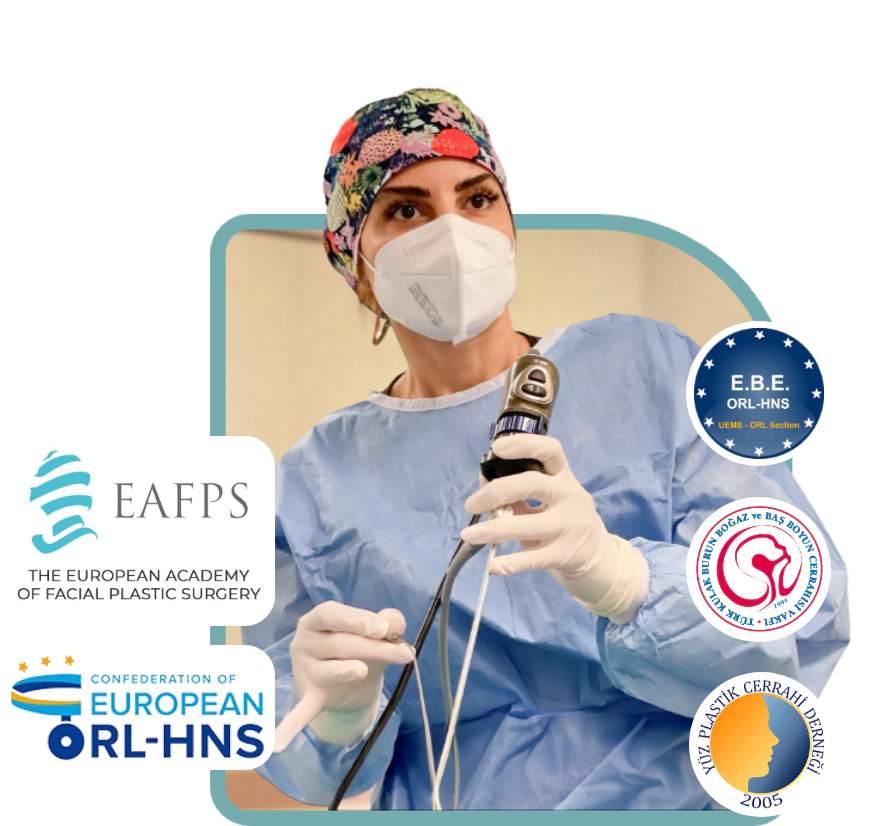
Op. Dr. Esin Özlem Atmış is an ENT and facial surgeon in Istanbul. She completed her specialist training in otorhinolaryngology at Ankara University Faculty of Medicine in 2014 and is a member of the Turkish Facial Plastic Surgery Association. She is one of the congress presidents of Face Bosphorus 3 (Istanbul, April 2026), a meeting on facial anatomy and medical practice. At Face Bosphorus 2025 she gave an opening talk and chaired sessions on the upper face and periorbital region, biostimulators and whole-face assessment; she was a listed speaker at Face Minima 2025, and at the 4th Congress of European ORL-HNS in Barcelona (2017) she chaired sessions that included facial anatomy. Details are on her scientific activities page.
This section brings together the facial operations she performs, from eyelid and brow surgery to the deep plane facelift. Rhinoplasty and voice surgery remain part of her practice and have their own sections.
Her approach starts with understanding the concern before discussing an operation: what has changed, how it affects you, and which structures are actually responsible. The aim is a proportionate plan that keeps your expression and character, which sometimes means a smaller procedure, a different order of treatment, or no surgery. Besides Turkish, she speaks English and Italian.
Frequently asked questions
Can several operations be done at the same time?
Often, for example eyelid surgery with a brow lift or a facelift.10,5 Combining them shortens the overall recovery period, but the operation is longer; the decision depends on your health and anatomy.
Do I need to come to Istanbul for the first consultation?
No. Most international patients start with an online consultation; the final examination and anaesthesia assessment take place in Istanbul at least one day before surgery.
How long should I stay in Istanbul?
About seven days after a facelift or neck lift and five to seven days after eyelid surgery; smaller procedures need less time.
Can follow-up be done online?
Yes. Reviews at 1, 3, 6 and 12 months can be done online for facial operations; nasal surgery needs in-person examination.
Clinical references
- Hohman MH, Raggio BS, Patel BC. Deep Plane Facelift. StatPearls, NCBI Bookshelf (updated 2026).
- Perioperative management of antithrombotic medications: guidelines from the American College of Chest Physicians (summary in Am Fam Physician, 2023).
- American Society of Plastic Surgeons. How nicotine sabotages plastic surgery.
- American Society of Plastic Surgeons. Neck lift.
- Cleveland Clinic. Forehead (brow) lift.
- Harvard Health Publishing. Buccal fat removal: what to know about cheek reduction surgery.
- American Society of Anesthesiologists. Herbal and dietary supplements and anesthesia (patient leaflet).
- American Society of Anesthesiologists. Multi-society guidance on GLP-1 receptor agonists before elective surgery (2024).
- Mayo Clinic. Face-lift.
- Mayo Clinic. Blepharoplasty.
This page is general information, not a personal diagnosis or treatment recommendation. Medicines must never be stopped without the advice of the doctor who prescribed them. Seek urgent medical care for heavy bleeding, rapidly increasing swelling, breathing difficulty, chest pain or sudden vision changes after surgery.
Start with a careful, honest consultation.
A consultation is not a commitment to surgery. It is where your concern, your anatomy and your health are looked at together.