

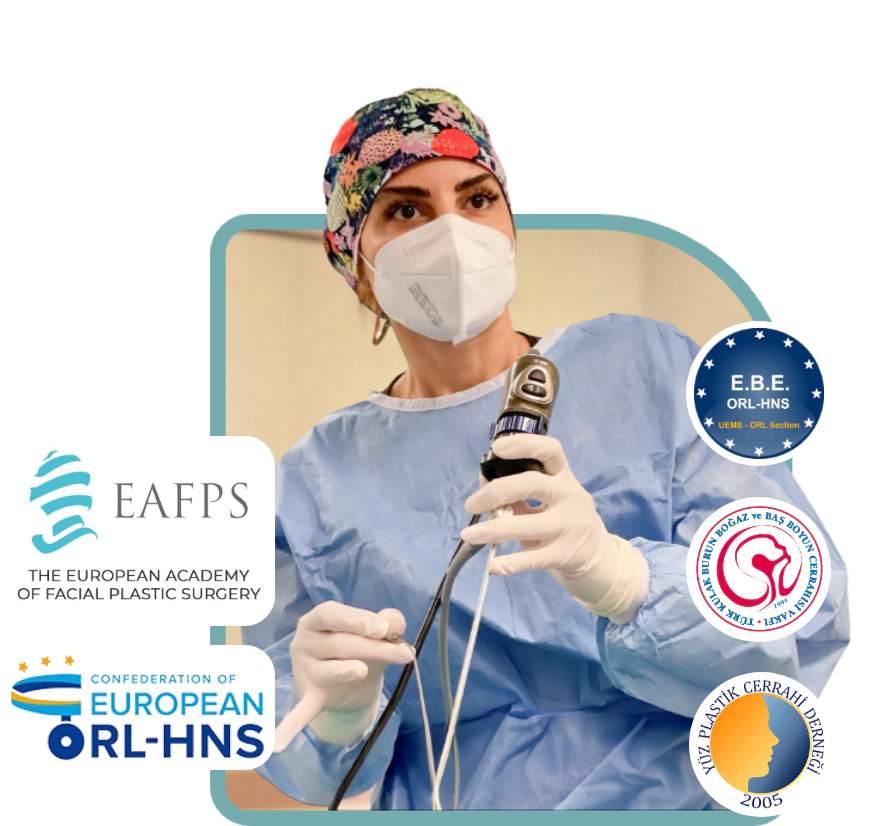
Dr. Esin Özlem Atmış
Otoplasty (Prominent Ear Correction)
Prominent ear correction for children and adults by an ENT surgeon, with incisions hidden behind the ear.
Facial surgery · Ears
Ears that sit closer, still shaped like ears.
Otoplasty reshapes, repositions or resizes the ears, most often for ears that stick out. It does not change hearing or where the ears sit on the head.1
It can be done once the ears have reached near-adult size, which allows surgery from about four to six years of age, and it is also common in adults.1 This page, part of our facial surgery section, explains how it is done, preparation, aftercare with the bandage and headband, risks and travel planning.
In short
- Incisions are behind the ear or in its natural creases; cartilage is folded and stitched into position.1
- Takes about one to two hours under general anaesthesia or local anaesthesia with sedation.1
- Bandages stay until the wound check at about a week; a headband is worn at night for about a month.2
- Results are usually long-lasting.1
- Plan about a week in Istanbul; follow-up can continue online.
Who otoplasty can help
- ears that stick out from the head;1
- ears that look large in proportion to the head;1
- a shape changed by injury or present from birth;1
- dissatisfaction with an earlier ear operation.1
Ear infections, hearing problems and other medical ear conditions are assessed separately within ENT care.
How otoplasty is done
Through an incision behind the ear or within its creases, the cartilage is reshaped: a missing fold is created with stitches, excess cartilage or skin may be removed, and the ear is set back to a natural distance from the head.1 The aim is symmetry and a natural contour from the front and from the side, not ears flattened against the head.
Before surgery: medicines, supplements and smoking
For children, the same medicine list applies to anything the child takes, including over-the-counter painkillers and supplements. Aspirin, anti-inflammatory medicines and herbal supplements increase bleeding and are usually stopped before surgery.1
Bring a written list of every medicine, injection and supplement you take, including doses. The table shows what usually happens; it is not an instruction to stop anything yourself. Blood thinners protect against stroke and clots, so any pause is agreed with the doctor who prescribed them.3
| Medicine | What usually happens before planned surgery |
|---|---|
| Warfarin | Usually stopped about five days before surgery; some patients need a temporary heparin injection plan.3 |
| Apixaban, rivaroxaban, edoxaban, dabigatran | Usually paused one to two days before, depending on bleeding risk; dabigatran needs longer when kidney function is reduced.3 |
| Clopidogrel, ticagrelor, prasugrel | If the cardiologist agrees, usually stopped about 5, 3 to 5, and 7 to 10 days before respectively. After a recent coronary stent, planned surgery is often postponed.3 |
| Aspirin | Often continued when it is taken to protect the heart; the decision is individual and made with your prescribing doctor.3 |
| Ibuprofen, naproxen and similar painkillers | Increase bleeding and are usually avoided before surgery; paracetamol is the usual alternative.4 |
| Vitamin E, ginkgo, garlic, ginseng and other supplements | Can increase bleeding; usually stopped at least two weeks before, sometimes three.5,6 |
| Weight-loss or diabetes injections (GLP-1 medicines such as semaglutide or tirzepatide) | Most people can continue them, but the anaesthesia team must know. Surgery may be postponed during dose increases or if you have nausea or vomiting; some patients need a liquid diet for 24 hours before.7 |
Bleeding disorders. Tell us at the first contact if you have a diagnosed bleeding disorder (for example von Willebrand disease or haemophilia), a low platelet count, liver disease, or a history of unusual bleeding after tooth extractions, operations or with periods. Blood tests and a haematology opinion come before any surgical plan. Some people are better served by not having elective cosmetic surgery at all.
Blood pressure and diabetes. Poorly controlled blood pressure or diabetes increases the risk of a collection of blood under the skin (haematoma) and of poor healing; both should be well controlled before surgery.6
Smoking and nicotine. Stop all nicotine, including vapes, patches, gum and snus, at least three to six weeks before surgery and for three to six weeks afterwards. Nicotine narrows small blood vessels and raises the risk of wound problems and skin loss; if you relapse, tell us, because postponing is safer.8
The operation
Otoplasty usually takes one to two hours. Children have general anaesthesia; adults can have general anaesthesia or local anaesthesia with sedation.1 A padded head bandage is applied at the end to protect the new shape.2
Recovery and risks
| Time | What is typical |
|---|---|
| First days | Discomfort and itching; no sleeping on the side or pressure on the ears; loose or button-down clothes1 |
| About 1 week | Bandage kept in place until the wound check; stitches that do not dissolve are removed2,1 |
| About 1 month | A loose headband worn at night so the ears do not fold forward during sleep2,1 |
| Several weeks | Bruising settles; sport and swimming resume once bruising and swelling have gone2 |
Risks include bleeding, infection, blood clots and reactions to anaesthesia, and, specific to otoplasty, visible scarring, asymmetry, changes in skin sensation and an over-corrected, “pinned back” look. Results are usually long-lasting; revision can be discussed if needed.1
Travelling to Istanbul for otoplasty
Many patients travel from other cities or countries. A clear plan makes the trip calmer and safer:
- Online consultation first: most international patients start with an online consultation. Send your concern, your medical history, your medicines and a few clear photos through the channel the practice arranges, before you book flights.
- Arrive at least one day before surgery: the anaesthesia assessment and the final examination take place before the day of the operation.
- Hospital stay: often the same day; an overnight stay is planned when general anaesthesia or the child’s comfort makes it sensible.
- Time in Istanbul: plan about a week, until the bandage is removed and the wound is checked.2
- Follow-up: reviews are planned at 1 month, 3 months, 6 months and 1 year. They can be done online if you live abroad; you will know whom to contact for urgent questions after you return home.
Dr. Atmış and ear surgery
Op. Dr. Esin Özlem Atmış is an ENT and facial surgeon in Istanbul. She completed her specialist training in otorhinolaryngology at Ankara University Faculty of Medicine in 2014 and is a member of the Turkish Facial Plastic Surgery Association. She is one of the congress presidents of Face Bosphorus 3 (Istanbul, April 2026), a meeting on facial anatomy and medical practice. At Face Bosphorus 2025 she gave an opening talk and chaired sessions on the upper face and periorbital region, biostimulators and whole-face assessment; she was a listed speaker at Face Minima 2025, and at the 4th Congress of European ORL-HNS in Barcelona (2017) she chaired sessions that included facial anatomy. Details are on her scientific activities page.
As an ENT surgeon, the ear is part of her everyday clinical work. The ear is also examined medically before cosmetic surgery, and the plan aims for ears that look natural from every angle.
Her approach starts with understanding the concern before discussing an operation: what has changed, how it affects you, and which structures are actually responsible. The aim is a proportionate plan that keeps your expression and character, which sometimes means a smaller procedure, a different order of treatment, or no surgery. Besides Turkish, she speaks English and Italian.
Frequently asked questions
What age is right for otoplasty?
Once the ears are close to adult size, which allows surgery from about four to six years; adults can have it at any age.1
Will it affect hearing?
No. Otoplasty changes the shape and position of the outer ear, not hearing.1
Can the ears go back?
Results are usually long-lasting. If one ear relaxes or the result is not satisfactory, a revision can be discussed.1
How long is the headband worn?
Usually at night for about a month after the bandage is removed.2
When can my child return to school and sport?
School usually about a week after the bandages come off; sport and swimming once bruising and swelling have settled.2
Can only one ear be operated on?
Yes, when only one ear is prominent, although both ears are assessed for symmetry.
Clinical references
- Mayo Clinic. Otoplasty.
- Hull University Teaching Hospitals NHS Trust. Otoplasty: information for parents (patient leaflet).
- Perioperative management of antithrombotic medications: guidelines from the American College of Chest Physicians (summary in Am Fam Physician, 2023).
- Mayo Clinic. Blepharoplasty.
- American Society of Anesthesiologists. Herbal and dietary supplements and anesthesia (patient leaflet).
- Mayo Clinic. Face-lift.
- American Society of Anesthesiologists. Multi-society guidance on GLP-1 receptor agonists before elective surgery (2024).
- American Society of Plastic Surgeons. How nicotine sabotages plastic surgery.
This page is general information, not a personal diagnosis or treatment recommendation. Medicines must never be stopped without the advice of the doctor who prescribed them. Seek urgent medical care for heavy bleeding, rapidly increasing swelling, breathing difficulty, chest pain or sudden vision changes after surgery.
Start with a careful, honest consultation.
A consultation is not a commitment to surgery. It is where your concern, your anatomy and your health are looked at together.