

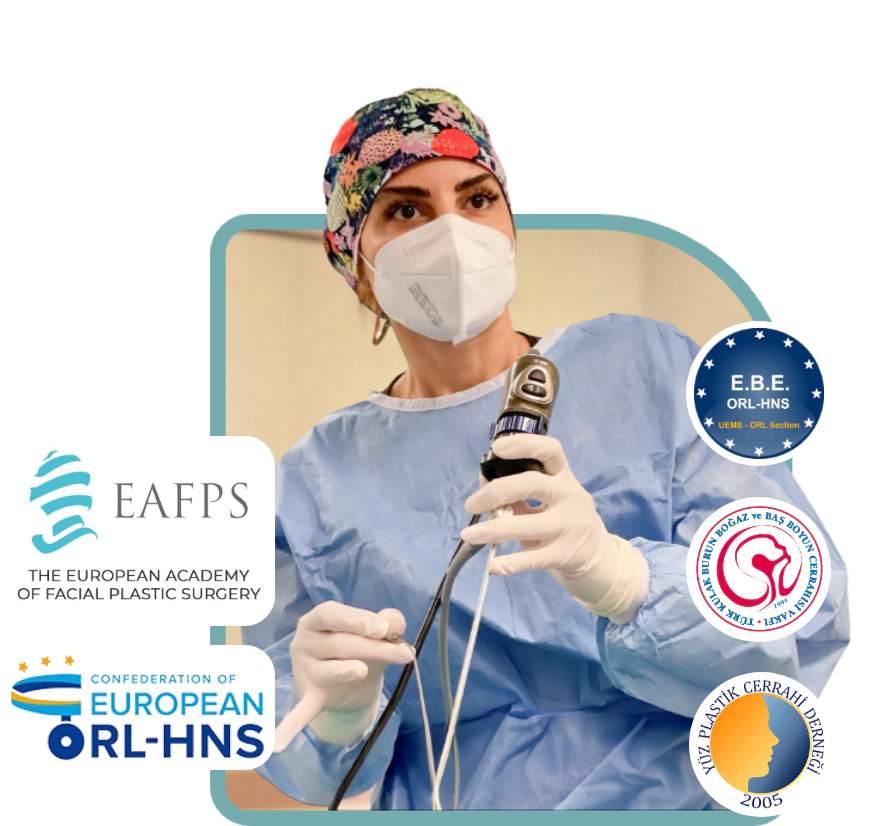
Dr. Esin Özlem Atmış
Eyelid Surgery (Blepharoplasty)
Upper and lower eyelid surgery in Istanbul, planned after checking the brow, the eye surface and the lower eyelid support.
Facial surgery · Upper and lower eyelids
Less heaviness, a more rested look, the same eyes.
Blepharoplasty removes or repositions excess skin and fat of the upper and lower eyelids. It may be considered for heavy, hooded upper eyelids, upper eyelid skin that partly blocks side vision, or bags under the eyes.1
Eyelid surgery cannot lift a low eyebrow. When the heaviness comes from the brow, a brow lift is needed instead of, or as well as, eyelid surgery.2 This page explains how that is decided, the eye checks before surgery, preparation, recovery, risks and planning a stay in Istanbul.
In short
- Upper eyelid incisions follow the natural crease; lower eyelid incisions sit just below the lashes or inside the eyelid.1
- Usually done under local anaesthesia with sedation; most patients go home the same day.1
- Bruising and swelling usually settle in 10 to 14 days; contact lenses are avoided for about two weeks.1
- Dry eye, glaucoma, thyroid disease and vision are checked before surgery.1
- Plan five to seven days in Istanbul; follow-up can continue online.
Who eyelid surgery can help
- Upper eyelids: excess skin that folds onto the lashes, a heavy or tired look, or skin that partly blocks the upper and outer field of vision.1
- Lower eyelids: bags caused by fat that has moved forward, and excess skin.1
Fine lines and dark pigmentation of the skin are different problems and usually need other treatments. A lid margin that droops because the muscle that lifts the eyelid is weak (ptosis) is also a separate condition, treated differently.
Eye checks before surgery
Before eyelid surgery you are asked about dry eye, glaucoma, allergies, circulation problems, thyroid disease and diabetes, and you usually have a full eye examination, tear production testing, visual field testing and photographs.1
Tear film
Dry eye can worsen after surgery, so it is treated and taken into account in the plan.1
Eyelid closure
Removing too much upper eyelid skin can make it hard to close the eye; skin is removed conservatively.1
Lower eyelid support
A loose lower eyelid can turn outwards after surgery (ectropion), so its tone is tested first.3
Brow and cheek
The brow above and the cheek below are assessed, because they change how the eyelids look.
Before surgery: blood thinners, supplements and smoking
Bring a written list of every medicine, injection and supplement you take, including doses. The table shows what usually happens; it is not an instruction to stop anything yourself. Blood thinners protect against stroke and clots, so any pause is agreed with the doctor who prescribed them.4
| Medicine | What usually happens before planned surgery |
|---|---|
| Warfarin | Usually stopped about five days before surgery; some patients need a temporary heparin injection plan.4 |
| Apixaban, rivaroxaban, edoxaban, dabigatran | Usually paused one to two days before, depending on bleeding risk; dabigatran needs longer when kidney function is reduced.4 |
| Clopidogrel, ticagrelor, prasugrel | If the cardiologist agrees, usually stopped about 5, 3 to 5, and 7 to 10 days before respectively. After a recent coronary stent, planned surgery is often postponed.4 |
| Aspirin | Often continued when it is taken to protect the heart; the decision is individual and made with your prescribing doctor.4 |
| Ibuprofen, naproxen and similar painkillers | Increase bleeding and are usually avoided before surgery; paracetamol is the usual alternative.1 |
| Vitamin E, ginkgo, garlic, ginseng and other supplements | Can increase bleeding; usually stopped at least two weeks before, sometimes three.5,6 |
| Weight-loss or diabetes injections (GLP-1 medicines such as semaglutide or tirzepatide) | Most people can continue them, but the anaesthesia team must know. Surgery may be postponed during dose increases or if you have nausea or vomiting; some patients need a liquid diet for 24 hours before.7 |
Bleeding disorders. Tell us at the first contact if you have a diagnosed bleeding disorder (for example von Willebrand disease or haemophilia), a low platelet count, liver disease, or a history of unusual bleeding after tooth extractions, operations or with periods. Blood tests and a haematology opinion come before any surgical plan. Some people are better served by not having elective cosmetic surgery at all.
Blood pressure and diabetes. Poorly controlled blood pressure or diabetes increases the risk of a collection of blood under the skin (haematoma) and of poor healing; both should be well controlled before surgery.6
Smoking and nicotine. Stop all nicotine, including vapes, patches, gum and snus, at least three to six weeks before surgery and for three to six weeks afterwards. Nicotine narrows small blood vessels and raises the risk of wound problems and skin loss; if you relapse, tell us, because postponing is safer.8
Bring your glasses and any eye drops you use. Contact lens wearers should plan to use glasses for about two weeks after surgery.1
The operation
For the upper eyelids, the incision follows the eyelid crease; excess skin, some muscle and fat are removed or repositioned. For the lower eyelids, the incision is made just below the lashes or on the inside of the eyelid, and fat is removed or redistributed.1 Eyelid surgery is usually done under numbing injections with intravenous sedation, and it can be combined with a brow lift or a facelift.1
Recovery and risks
| Time | What is typical |
|---|---|
| First night | Cold packs for 10 minutes every hour, then four to five times a day; sleep with the head raised1 |
| First days | Temporary blurred vision, watering, light sensitivity, puffy or numb eyelids1 |
| About 1 week | Stitches or adhesive strips removed; no strenuous exercise, swimming or heavy lifting3,1 |
| 10–14 days | Bruising and swelling mostly settled; many people return to work at about two weeks1,3 |
| About 2 weeks | Contact lenses can usually be worn again1 |
| Months | Scars fade and become hard to see1,3 |
Risks include dry or irritated eyes, difficulty closing the eyes, noticeable scarring, injury to eye muscles, skin discolouration, a lower eyelid that turns outwards, bleeding, temporary blurred vision and, very rarely, loss of vision.1,3 Seek urgent care for severe new eye pain, bleeding or a change in vision.1
Travelling to Istanbul for eyelid surgery
Many patients travel from other cities or countries. A clear plan makes the trip calmer and safer:
- Online consultation first: most international patients start with an online consultation. Send your concern, your medical history, your medicines and a few clear photos through the channel the practice arranges, before you book flights.
- Arrive at least one day before surgery: the anaesthesia assessment and the final examination take place before the day of the operation.
- Hospital stay: eyelid surgery alone is often a same-day procedure under local anaesthesia with sedation; when it is combined with other surgery or done under general anaesthesia, one night is planned and a second night is optional.
- Time in Istanbul: plan five to seven days after surgery, which covers the first checks and the removal of stitches.
- Follow-up: reviews are planned at 1 month, 3 months, 6 months and 1 year. They can be done online if you live abroad; you will know whom to contact for urgent questions after you return home.
Dr. Atmış and the eyelids
Op. Dr. Esin Özlem Atmış is an ENT and facial surgeon in Istanbul. She completed her specialist training in otorhinolaryngology at Ankara University Faculty of Medicine in 2014 and is a member of the Turkish Facial Plastic Surgery Association. She is one of the congress presidents of Face Bosphorus 3 (Istanbul, April 2026), a meeting on facial anatomy and medical practice. At Face Bosphorus 2025 she gave an opening talk and chaired sessions on the upper face and periorbital region, biostimulators and whole-face assessment; she was a listed speaker at Face Minima 2025, and at the 4th Congress of European ORL-HNS in Barcelona (2017) she chaired sessions that included facial anatomy. Details are on her scientific activities page.
The eyelids are part of the periorbital region, the area she chaired sessions on at Face Bosphorus 2025. In practice this means that the brow, the eyelid and the cheek are assessed together before deciding how much skin, if any, should be removed.
Her approach starts with understanding the concern before discussing an operation: what has changed, how it affects you, and which structures are actually responsible. The aim is a proportionate plan that keeps your expression and character, which sometimes means a smaller procedure, a different order of treatment, or no surgery. Besides Turkish, she speaks English and Italian.
Frequently asked questions
Will eyelid surgery change the shape of my eyes?
The aim is to remove heaviness while keeping your eye shape. Changing the angle of the outer corner is a different operation; see almond eye surgery.
Is it painful?
Most people have discomfort rather than severe pain in the first days; cold packs and paracetamol are usually enough.1
When can I wear contact lenses again?
Usually after about two weeks.1
How long do the results last?
For some people results last a lifetime; for others, eyelid heaviness can return with time.1
Can upper and lower eyelids be done together?
Yes, when both need treatment. They can also be combined with a brow lift or a facelift.1
When should I seek urgent help after surgery?
For shortness of breath, chest pain, severe new eye pain, bleeding or a change in vision.1
Clinical references
- Mayo Clinic. Blepharoplasty.
- Cleveland Clinic. Forehead (brow) lift.
- NHS (UK). Eyelid surgery.
- Perioperative management of antithrombotic medications: guidelines from the American College of Chest Physicians (summary in Am Fam Physician, 2023).
- American Society of Anesthesiologists. Herbal and dietary supplements and anesthesia (patient leaflet).
- Mayo Clinic. Face-lift.
- American Society of Anesthesiologists. Multi-society guidance on GLP-1 receptor agonists before elective surgery (2024).
- American Society of Plastic Surgeons. How nicotine sabotages plastic surgery.
This page is general information, not a personal diagnosis or treatment recommendation. Medicines must never be stopped without the advice of the doctor who prescribed them. Seek urgent medical care for heavy bleeding, rapidly increasing swelling, breathing difficulty, chest pain or sudden vision changes after surgery.
Start with a careful, honest consultation.
A consultation is not a commitment to surgery. It is where your concern, your anatomy and your health are looked at together.